
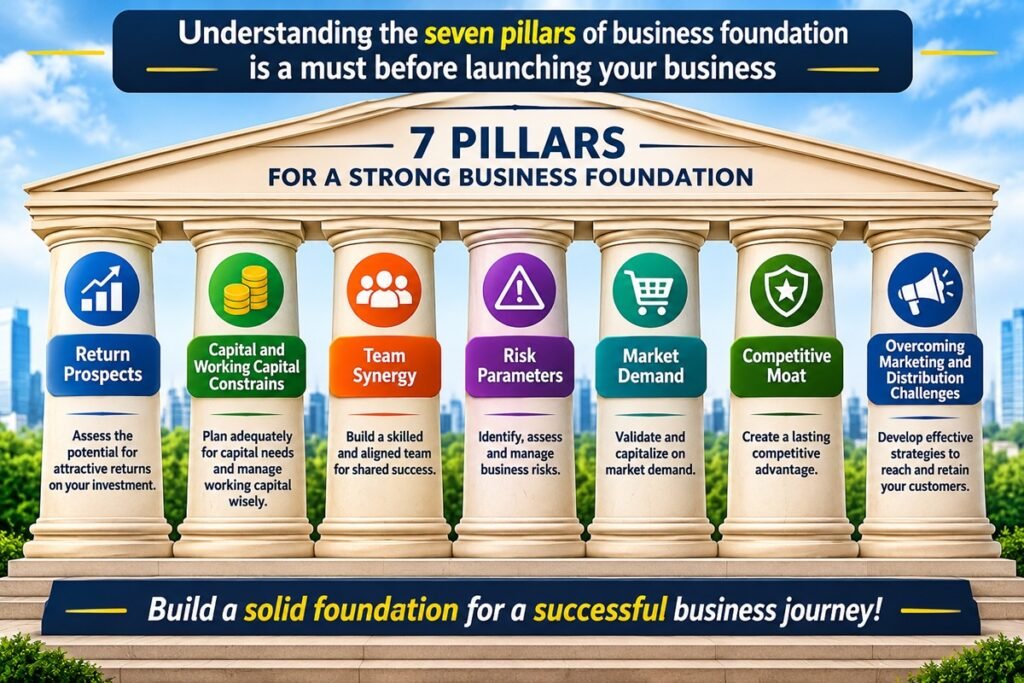
Starting a business and becoming a successful entrepreneur might be a dream that you passionately ensue for a long time. Many spoil their game with a hasty start or with overwhelming enthusiasm that create myopic visions. A strong vision is not gained with passionate thinking about your business in a positive manner. On other hand, It is gained if you deeply understand these seven foundational pillars of business.
- Return prospects :- Finding the best equation for healthy net profit margin is an exercise which requires deep research and real time experience. According to NYU stern study conducted by Professor Aswath Damodaran[i] states that the average net margin is 9.74% . Roughly it may range from 7% to 30% depending upon the industry dynamics and competitive advantage of the business. Reasonable good estimation of net margin and amount of business gives a fairly good idea about the profit prospective of business.
- Capital and working capital constrains:- Capital is the blood of the business and adept in managing working capital is one of the main criteria that determines the health of the business. Understanding more about the technology, machinery, manufacturing process, infrastructural facilities etc will give a fair good idea about the initial capital requirement. Understanding the cash flow mechanism of the business coupled with demand driven optimum production gives a fairly good idea about the working capital requirement and efficient management of Working capital.
- Team Synergy :- Most of the time , it is not the idea that fails but the execution of idea that fails. It is a hilarious task to blend a group of people to derive a positive outcome. Ego clashes, performance asymmetry, bad office politics, lack of transparency and diffusive efforts all have a major role in the failure of business. Selection of right people is the most important aspect when we realize that it is not easy to motivate and reform a person until and unless he himself have a strong desire for such a transformation.
- Risk parameters :- The proverb “Never test the depth of the river with both legs” gives a fairly good idea on how to deal with risk in the business. Understanding and implementing pragmatic approach towards the six core areas of risk like financial, market, operational, legal & regulatory, strategic and reputational risk will help the entrepreneur to successfully handle the vulnerabilities in business.
- Market demand:- The measure of organic demand to a great extend determines the survivability of a business. Organic demand is the demand that is derived without any effort and it is gained just by starting a business in a right environment. Understanding the local demography and consumer buying preferences might help for a fairly good estimation of organic demand. It is also important to know how the quality and price impact the market demand structure. The details of latent demand or pull demand gives good idea about the marketing strategy for the business but for new business man it is always a forbidden apple.
- Competitive Moat :- The concept of Economic moat is popularized by Warren buffet. In simple word moats means it is whatever that stops the competitors to steal your customers. Strong brand names, customer satisfaction, extensive networks, intellectual property rights and cost advantage might give a strong competitive moat to the business.
- Overcoming Marketing and distribution challenges:- It is a bare reality that many small business don’t have a marketing team. It is perceived as an additional expense without realizing that your have built a beautiful, strong horse cart with no horse to pull it. Many new comers are least prepared about the logistics and distribution expenses and they learn it by burning their fingers. A deep thought about how to reach a prospective customer helps the entrepreneur to move ahead rather than drowning in the whirlpool of market challenges
[i] https://pages.stern.nyu.edu/~adamodar/New_Home_Page/datafile/margin.html